After a really dry start to 2026, the West will turn stormier over the next 10 days

In brief: After a long dry spell, there are signs of stormier weather in the West over the next 10 days. Mountain snow and low elevation rain is likely to add up some, helping to ease the deficit pain a bit but not enough to truly “salvage” winter at this point.

The dry West should moisten up a bit

It’s been a minute since we’ve shifted focus to the West. And for good reason: It’s been dead quiet.

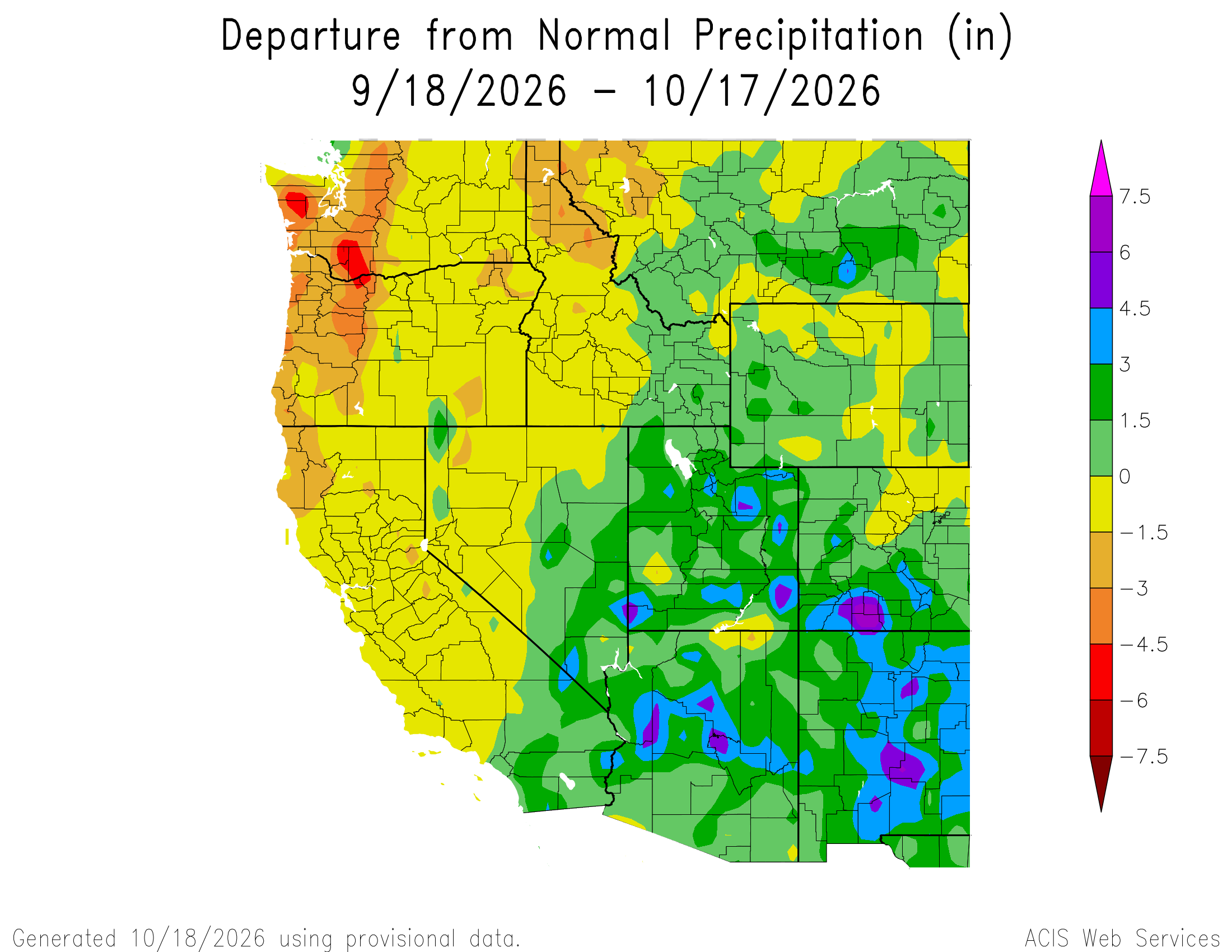
Precipitation as a percentage of normal over the last 30 days has been meager at best in the entirety of the West, except for the coastal Olympic Peninsula. (High Plains Regional Climate Center)

This snow season has been wretched in the West too. While precipitation isn’t terribly far off normal for the season, the ratio of rain to snow events has been severe limiting any snowpack gains in the West. In fact, a look at the map of snow water equivalent by basin in the West paints a dire story right now, particularly as high stakes Colorado River water supply negotiations extend deeper into overtime.

Virtually every Western U.S. hydrologic basin is running below median for snow water equivalent at present, with most basins running 50% or less than median. (USDA)

That map is downright unsustainable in the current hydrologic environment of the West. So, help is needed, badly. Thankfully, some help is on the way. The first in what should be a series of storms arrives in California tonight. This system is less atmospheric river and more just a low pressure system that looks to stall out for a couple days. This is optimal, as it will bring mountain snow and lower elevation rain to much of the region, as well as at least some snow inland. Snow levels will be somewhat high-ish but you have to start somewhere.

(NWS Sacramento)

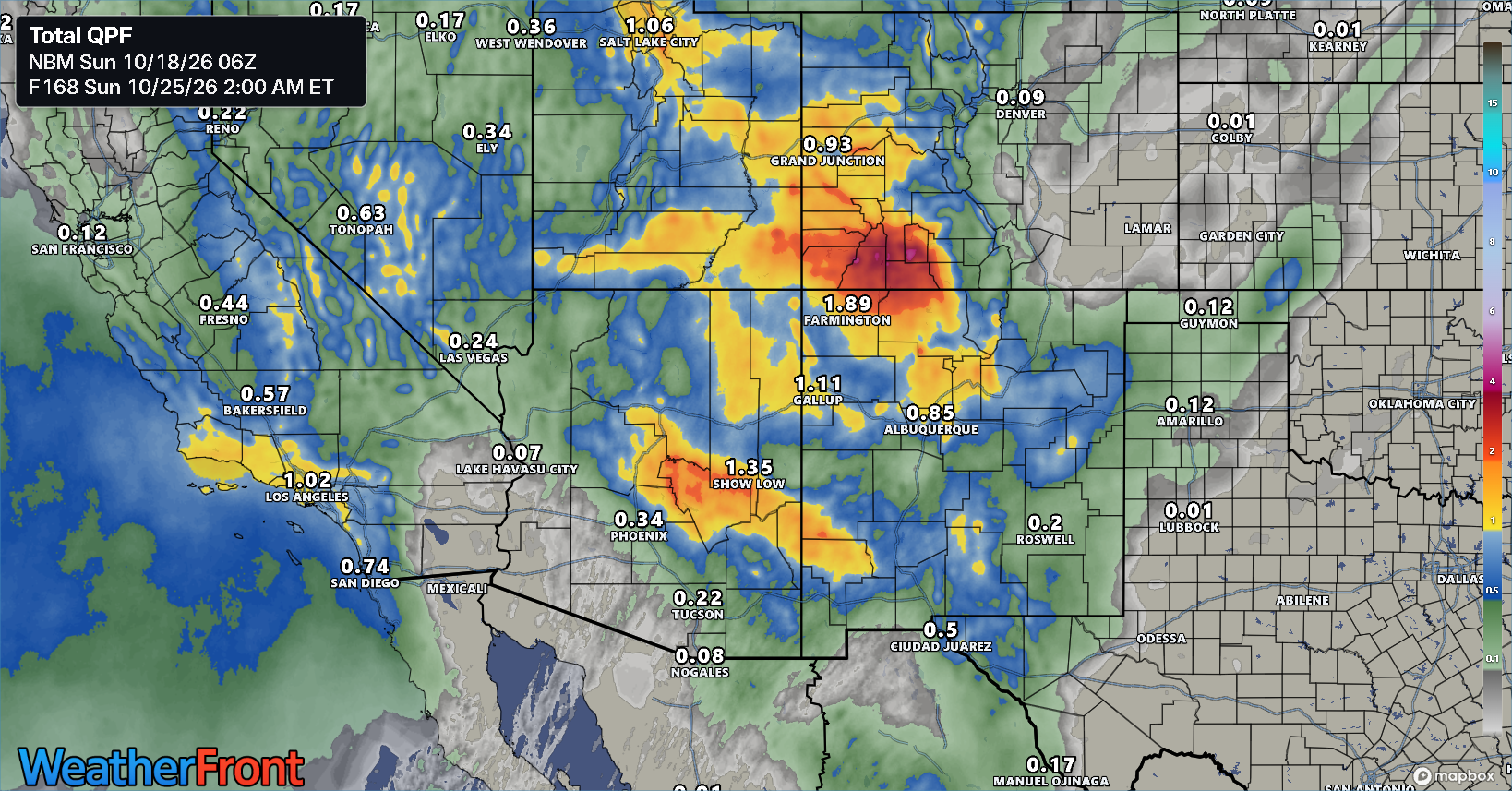
This should allow for 1-2 feet above 6,000 feet in the Sierra. Importantly, some of this snow will make into the interior mountains of Utah, Idaho, and Wyoming too, with perhaps 6 to 12 inches of snow at higher elevations.

(NWS Salt Lake City)

After this week’s system sort of washes out on Thursday, our attention will focus to a potential series of storms, more akin to a classic atmospheric river next week that should further add some snow and low elevation rain to the mix. Don’t sleep on the high winds outlined there either. We could be looking at some fire weather concerns in the Rockies or High Plains.

It looks busy in the West after this week. (NWS CPC)

The Climate Prediction Center’s 8-14 day hazards outlook has begun to paint the West more colorfully since Saturday. The heavy precipitation and heavy snow cards are being dealt for Feb 17-19 with the storm(s) next week. When all is said and done, we could be looking at 5 to 10 inches of liquid equivalent in California and 1 to 3 inches in portions of Nevada, Utah, Arizona, and western Colorado. Anything would help. This won’t be enough to salvage the winter (we need more), but it will hopefully help pull back the extremes a little. Here’s hoping.

Editor’s Note: We’re still doing this

I have a recurring Google News search on that I get sent to my email daily for “flash flooding,” “flood mitigation,” and “hurricane Gulf” (in Google Scholar). So, I see a lot of news and information on flooding each week. One story caught my eye yesterday, and it makes me extraordinarily frustrated.

The Unicoi County Hospital in Tennessee flooded so badly during Helene that patients and staff had to evacuate to the roof and be rescued by helicopter. The decision is being made to rebuild the hospital right in the flood plain of North Indian Creek, a location that may be even worse than where it was originally built. There are safe ways to do this to ensure flood impacts are mitigated, but unfortunately, Ballad Health did not offer comment for this article. This doesn’t make me angry because rural health systems struggle enough as it is, and it’s more important to offer those residents access to healthcare than it is to worry about everything else. Theoretically. But it frustrates me that organizations like this are being put in this position at all. Surely, there have to be many other, less flood prone locations to build this facility. When we talk about resiliency and building smartly, which we should be doing in 2026, no matter your belief structure on climate change, this is exactly what we don’t want to see happening. Risk is never zero, of course. But some risks are very clearly worse than others, and this decision feels as if it feeds into that idea. It’s hard enough for rural health systems to survive on a good day, let alone with elevated risk. They need help with ways to build smarter.

Coldest morning in over 35 years in parts of Florida, while the Carolinas dig out from a massive, challenging snowstorm

In brief: Today’s post recaps historic cold in Florida this morning and the snowstorm in the Carolinas yesterday. We also take a closer look at the Raleigh-Durham area specifically, which saw relatively little snow compared to the rest of North Carolina and why that happened.

Florida freeze & Carolina snow

Let’s talk first about Florida.

Morning lows in Florida, the Bahamas, and parts of the Southeast were very, very cold. (NOAA)

In Jacksonville, the temperature hit 22 degrees for the second time this winter (last seen on January 16th). The wind chill got as cold as 11 degrees there this morning for the first time since January 2014.

It was the coldest February morning on record in parts of Central Florida. (NWS Melbourne)

In Orlando, the morning low of 24 degrees was last seen on December 29, 2010 and prior to that Christmas Eve 1989. For Daytona Beach, the 23° morning low was coldest since Christmas 1989. This was also the coldest February morning on record there. Vero Beach and Sanford also had their coldest February mornings back to the 1940s or 1950s as well.

On the Gulf side it was not quite as cold, as Tampa hit 28° (coldest since 2010), Sarasota hit 36° (coldest since 2022), and Fort Myers bottomed out at 34° this morning (coldest since 2018).

Prior to today, numerous places in South Florida have not seen temperatures this cold since at least 2010, if not 1989. (NWS Miami)

The 30° low in West Palm Beach was the coldest since Christmas Day 1989. Wind chills got down to 20° as well.

For Miami, the morning low of 35° was the coldest since January 10, 2010, when they also hit 35 degrees. Prior to 2010, it last happened on January 21, 1985, when it was 34° in Miami. The wind chill of 26 degrees in Miami at 7 AM appears to be the first time that’s happened since the great cold outbreak of Christmas 1989.

For Key West it was only the 5th time in the last 10 years they’ve hit 52° or colder.

Overall, this was a top tier, borderline hall of fame cold outbreak for Florida.

Carolinas snow

Yesterday’s snowstorm was rather amazing for portions of the Carolinas, with some places seeing historic snow totals.

Observed snowfall across the Mid-Atlantic and Appalachia. (Pivotal Weather)

The highest totals I could find were near Faust, NC north of Asheville, where 22.5 inches fell and Peletier, NC, which is just inland from Emerald Isle and just west of Morehead City where 19.5 inches fell. 19 inches was reported near New Bern, NC in Olympia and in Reelsboro, just east of there. It would appear that this is the modern storm of record for portions of southeast North Carolina. New Bern’s previous snowstorm record was 15.5 inches in January 1965. Closer to Wilmington and Myrtle Beach, it was the largest snowstorm since 1989.

Farther inland, Charlotte’s 11.3 inches was the largest snowstorm there since 2004. 10.3 inches was measured in Greensboro, the largest snow there since December 2018.

The RDU snow desert

Interestingly, if you look back at the forecasts ahead of the storm, the Raleigh-Durham area was expected to see 8 to 12 inches of snow, roughly. In reality, they ended up closer to 2 to 5 inches. What the heck happened? In snowstorms like this, you often get these significant mesoscale type impacts that take place. In other words, it’s stuff happening at the small scale that causes outsized impacts.

Radar as of midday on Saturday showing two focused areas of snow, one near the coast and one well inland, leaving Raleigh high and dry. (College of DuPage)

What seems to have happened yesterday is that the Raleigh-Durham area ended up under a band of sinking air, or subsidence, in between two areas of rising air, one inland and one closer to the developing coastal storm itself. As these transitions to coastal storms happen, you’ll occasionally see that happen. This allowed for snow to accumulate more rapidly inland and near the developing storm before the storm blew up and dumped snow on everyone. There were hints of this in the modeling if you squinted hard enough, which is easy to do when you’re analyzing an event after the fact. But there was nothing clear cut that said the RDU area would be snow-deserted for so long. But if you look at the vertical velocity forecast from Saturday’s 12z NAM model, you can indeed see that basically happening.

Saturday’s 12z NAM model showing a double area of rising air and a gap in between indicating the possibility of a corridor of minimal snow totals in between two maxes. (Pivotal Weather)

You aren’t going to look at this and say, “Raleigh is going to get no snow,” but it does at least show a slightly better visual of the potential of a vertical velocity minima/subsidence in the atmosphere that would “gap” an area from seeing heavier snow. It’s not as if this was clearly defined or setup the day before. There were hints of something down toward Fayetteville or the Pee Dee in South Carolina on Friday morning. That shifted closer to the Triad with Friday afternoon’s model guidance. But you aren’t going to look at that alone and sketch a forecast that granular in nature and feel confident. It’s just the challenging nature of these snowstorms.

Major storm impacts parts of the Mid-Atlantic this weekend, with a major Florida freeze as well

In brief: A major winter storm is going to impact the Carolinas and Virginia this weekend, with significant snow, wind, and tidal flooding. Behind the storm, the coldest air mass in over 15 years will settle over Florida leading to an extremely serious freeze there. All that and a dispatch from the annual meeting of the American Meteorological Society.

Good Friday afternoon all. First off, I do have to apologize for a lack of posts. My day job requires significant time investment off hours when weather gets serious in Houston, and with the threat of ice last weekend, I was completely void of free time. This week also marked the annual meeting of the American Meteorological Society here in Houston. I’ve been quite involved in organizing and planning sessions and socializing with colleagues in the community. More on both of those items below.

Weekend storm

As many of you have been tracking through the week, a massive storm is going to blow up off the Mid-Atlantic coast beginning tomorrow. It has been a week of nauseatingly challenging changes to the forecast track. I want to step back real quick. Let’s go back to Monday’s 00z European ensemble run.

Model IQR difference between 75th and 25th percentile for European surface low placement from Monday’s 144 hour forecast. (Polarwx.com)

If you look at the spread in interquartile range between the 75th and 25th percentile sea level pressure forecast from back on Monday, you can clearly identify a rather large spread off the Carolina coast. The mean position of the low is actually not far off where it should ultimately locate. But in general, it was pretty evident that there was a significant degree of uncertainty. That uncertainty expanded on Monday then contracted later Tuesday and Wednesday. And now we’re focused on a southern track storm.

In general, the storm should develop and intensify off the coast of Capes Hatteras and Lookout. It will then move east-northeast out to sea rather than up the East Coast, at least initially. High pressure in the upper atmosphere over eastern Canada will help suppress the storm a bit. Eventually, the low finds its way into the Canadian Maritimes likely bringing blizzard conditions to parts of Nova Scotia and Newfoundland.

The forecast from the European operational model for the weekend storm. (Pivotal Weather)

To be clear, the term “bomb cyclone” and “bombogenesis” are valid here, but this is a strong nor’easter. The other terms reference specific meteorological definitions of intensification and sound cool. Otherwise, they’re meaningless. A cyclone “bombs out” if it strengthens at least 24 millibars in 24 hours. This one deepens from about 1010 mb once offshore tonight to about 976 mb tomorrow night, a drop of about 34 mb. That’s a bomb. It’s also a strong nor’easter.

So what sort of situation are we looking at here? A lot of snow for the Carolinas and southeast Virginia.

Official NWS snowfall forecast for the Carolinas and Virginia. (NOAA)

The snowfall forecast suggests a wide swath of 6 to 12 inches from Columbia, SC through Fayetteville and toward the Virginia Tidewater. There are signs of potentially higher amounts embedded within that. It is possible that we see some lower amounts too, but the probability of seeing 6 inches or more of snow is basically 60 to 70 percent or higher for the orange shaded regions. Either way, this looks like a very impactful snowstorm for the Carolinas and southeast Virginia.

Farther north, there will be significant snow in the Canadian Maritimes as well. Anywhere from 20 to 30 cm or more of snow is likely between Nova Scotia and Newfoundland, particularly the Avalon Peninsula.

Heavy snow will impact the Canadian Maritimes this weekend into Monday. (Pivotal Weather)

Blizzard conditions are likely in some of those areas with the combined wind and snow.

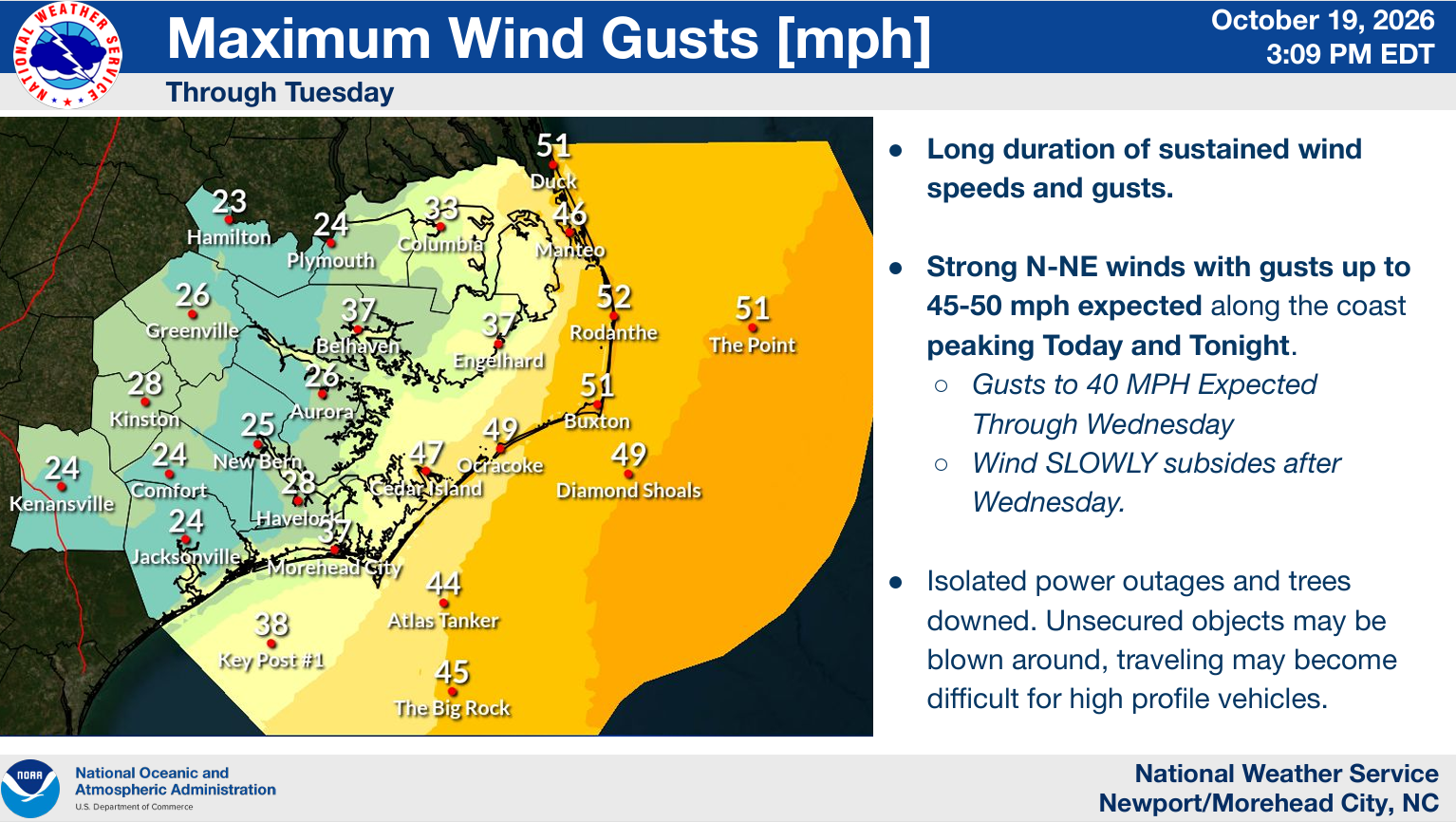
Speaking of winds, max wind gusts are expected to be on the order of 50 to 60 mph on the coast of North Carolina and Virginia.

Forecast maximum wind gusts from the NBM model on Sunday. (NOAA)

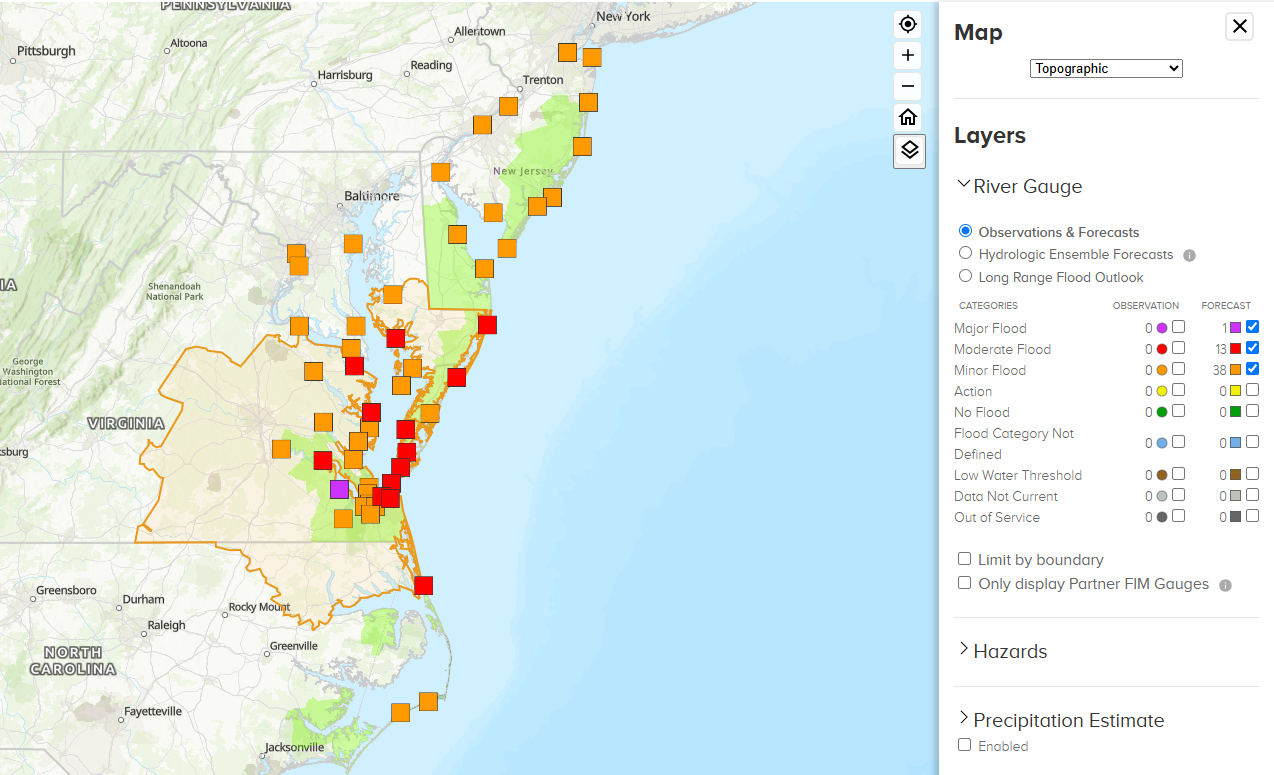
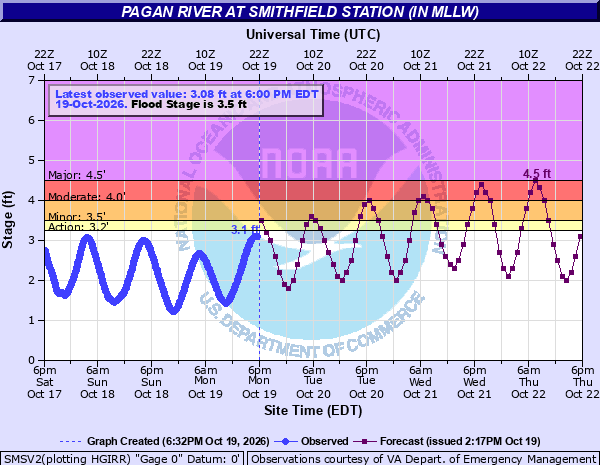
Current tidal forecasts suggest that the combination of winds and seas will lead to minor or moderate flooding on the soundside of North Carolina and major flooding on the oceanfront, particularly the farther up the coast you go. The tide forecast at Duck, NC shows a 7.2 foot tide level for Sunday morning’s high tide.

The forecast tidal levels at Duck, NC is forecast to be the highest since 2019. (NOAA)

To put this in perspective, the forecast at Duck is higher than any of the tropical events this summer and the highest since September 2019, or during Hurricane Dorian. The only other higher tides were with Isabel in 2003 and during the powerful November 2006 nor’easter. The tidal forecast farther up the coast in Virginia is more in line or slightly lower than this past summer’s tropical events.

So, bottom line: Wind, cold, and snow. Minimal ice is expected but sleet or plain rain may mix in closer to the coast of the Carolinas.

What about cold? On the backside of this storm, some intense cold air is going to drop into the Southeast. Dozens of records may be threatened, particularly farther south away from the storm into Georgia and Florida. Sunday morning’s low temperature is forecast to be 25 degrees in Orlando, 22 in Jacksonville, and 32 in West Palm Beach. Even Miami gets down to 38 degrees. If that happens, it will be Miami’s coldest morning in 16 years.

The potential for record cold is high on Sunday morning in Florida, with the coldest morning in years in some places expected. (Pivotal Weather)

This will be a severe freeze for the state of Florida.

Cold weather is expected to continue in the East for a while longer however. We may not be done yet.

Ice storm recovery continues, and I encourage you to check out Alan Gerard’s Balanced Weather for more on the impacts and recovery.

AMS Annual Meeting Takeaways

Lastly, the American Meteorological Society, the largest professional organization for meteorologists held their annual meeting this week in Houston. I attended this event and talked to numerous people about the state of affairs right now. A few quick observations I feel are relevant for the general public to understand:

First, the students and young, early career professionals in our field are exceptionally optimistic and motivated. I heard so many students say that their dream jobs are at the National Weather Service or in broadcasting. Both of those areas have seen an exodus of talented individuals in recent years, with NWS accelerating in the last year. Despite all the struggles and hurdles in last year, these students are still committed to serving the public, and I think that’s amazing.

Second, also despite the hurdles and challenges, the science is enduring. Research does continue, though it is handicapped and being slowed down. But in general, the work continues. And while I won’t say the vibe is optimistic, it is focused on the tasks at hand.

Third, there is grave concern about NCAR being shut down, and there is great concern about what that means regarding a lot of the ongoing and upcoming research. While the work continues, losing NCAR, even if it means “redistributing” its mission to another agency would cause a lot of unnecessary headaches and seems to be a woefully inefficient use of federal resources. Make of that what you will, but it’s disappointing that the verbiage to protect NCAR was not agreed to in the otherwise pretty good appropriations bill passed by Congress.

A number of federal colleagues were not allowed to travel to the meeting, which was deeply felt for sure. The weather also played a role. But in general, I expected a slightly more negative, pessimistic vibe this week. While reality drives some of that for sure, the slightly more positive takes really stood out to me. We’ll see how it goes next year in Denver.

Southern snow, return of cold, windy Plains, Pacific tropics?

In brief: A winter storm may bring some minor snow accumulations to rather far south latitudes this weekend, including perhaps all the way to northern Florida. That will be followed by some cold and the potential for some healthy cold later next week in the North. In addition, we’re going to see some wild winds in the Plains, and we’re also actually looking at the Eastern Pacific for possible tropical development.

Hello after a bit of a hiatus! Let’s get into some winter.

Florida flakes?

I’m presenting at the annual meeting of the American Meteorological Society later this month here in Houston on comparisons between last January’s snow that established a new state record in Florida and covered much of the Gulf Coast in white and an 1895 event that had some similarities. Gulf Coast snow is somewhat rare, certainly uncommon, so it’s newsworthy whenever it happens. And indeed, as we approach this weekend, we’re at it again!

As this week has progressed, we’ve begun to see the beginnings of a pattern change, starting with a pretty potent upper level trough of low pressure digging into the Eastern U.S., deep into the Southeast. Low temperatures tonight are expected to be in the 20s in the Florida Panhandle and 30s down to Tampa and Orlando.

Morning lows on Friday are forecast to be quite chilly in Florida. (Pivotal Weather)

After a brief push of moderation, the weather will again turn colder this weekend as a very sharp disturbance within the trough carves out near Texas and Louisiana and pushes east off the East Coast. As this happens, a shield of rain is going to develop off the Texas and western Louisiana coasts in the Gulf and rocket east northeast. Because the trough is so deep, the storm track will be somewhat suppressed, meaning any low pressure that forms will be off the South Carolina or Georgia coasts.

A potent disturbance will swing through the Southeast this weekend bringing a chance of rain and mixed rain and snow to places that are not accustomed to seeing much of that! (Pivotal Weather)

With cold air moving back in place on the backside of this storm, it seems possible, if not likely that rain will mix with or change to snow over parts of the Southeast. While this probably won’t be a major snowstorm, the prospect of a few inches of snow in some parts of the Southeast, say from the Florida Panhandle, across south Georgia, into South Carolina is definitely interesting!

(NWS Charleston)

The area most likely to see something on the order of 1 to maybe up to 3 inches of snow is likely from north of Tallahassee through Valdosta into maybe Augusta and Columbia, SC. Current snow forecasts are not exactly major through 7 AM on Sunday, but it’s something! Keep posted to your local forecasts in the South for more over the next couple days.

Current snow forecasts through Sunday morning 7 AM. (NWS Atlanta)

Let’s welcome winter back to the Southeast after what has been a rather lengthy stretch of mostly mild, at times record warm weather.

Winter is likely to stick around a bit. While the South may see more variability at times, the Midwest is likely going to see some legitimate cold coming. The CPC has highlighted the Dakotas, Minnesota, the Wisconsin Northwoods, and the U.P. of Michigan for “much below normal” cold Jan 24-26.

The 8-14 day hazards outlook is now highlighting cold risk in the North beginning late next week. (NOAA CPC)

The pattern does indeed look healthy for cold, legitimate cold in some places, particularly the Upper Midwest and Great Lakes. Meanwhile, how far east and south will it get? That’s more of an open question. The same 8-to-14-day outlook shows high confidence cold in the North and moderate confidence for more warm weather in the South.

Warm South, cold North, same as it ever was? (NOAA CPC)

Over the last 30 days, record highs have outpaced record lows by a 29:1 margin (5,210 to 181). Much of that is due to a very warm South and West late last month and a very warm start to 2026 nationally.

Jan 1-12 temperature anomalies across the country have skewed extremely warm. (NOAA PSL)

The next week or two will erase a good bit of that warmth out of there, but we’ll see if that includes the South.

Windy Plains!

Elsewhere, the main weather story the rest of this week will be winds on Friday in the Plains and northern Rockies, with wind gusts perhaps as high as 75 to 80 mph in parts of South Dakota. This will lead to all sorts of issues in that area, including some higher fire risk.

(NWS Rapid CIty)

Winds peak Friday morning.

Slight chance at an Eastern Pacific tropical system?

Yes, it’s January. Yes, there may actually be a tropical system in the eastern Pacific. Maybe. If you’ve heard about it, it still seems unlikely, but there is some model support for it.

Thunderstorms in the Eastern Pacific may have a very, very slight chance at becoming a tropical system as it moves northwest offshore of Mexico. (Weathernerds.org)

Modeling suggests that as this drifts northwest, it has at least a very, very slight chance at organizing to a point where it could be a weak depression. Water temperatures in this part of the world are much warmer than normal, which won’t hurt. And yes, Google’s Deep Mind model does show a low chance of this happening too. Support is not great by any means, but there’s enough there there that from a purely meteorological curiosity perspective, this will be interesting to monitor.

A few European ensemble and Google Deep Mind ensemble members do show tropical development possibilities in the Eastern Pacific over the next few days. (Google Weather Lab)

The last time we saw a wintertime tropical system in the Central or Eastern Pacific occurred in January of 2016, when Hurricane Pali formed in the Central Pacific, south and west of Hawaii. In the Eastern Pacific, you really need to go back to December of 1983 for this, with Hurricane Winnie that formed south of Mexico, a few hundred miles east of where this disturbance currently is located. Weird? You bet. Not at all normal. In most cases when this happens, it occurs closer to Hawaii or the International Date Line. Another storm in 1922 formed in February somewhere south of here but details are a bit sketchy. Either way, a notable weather item today.